
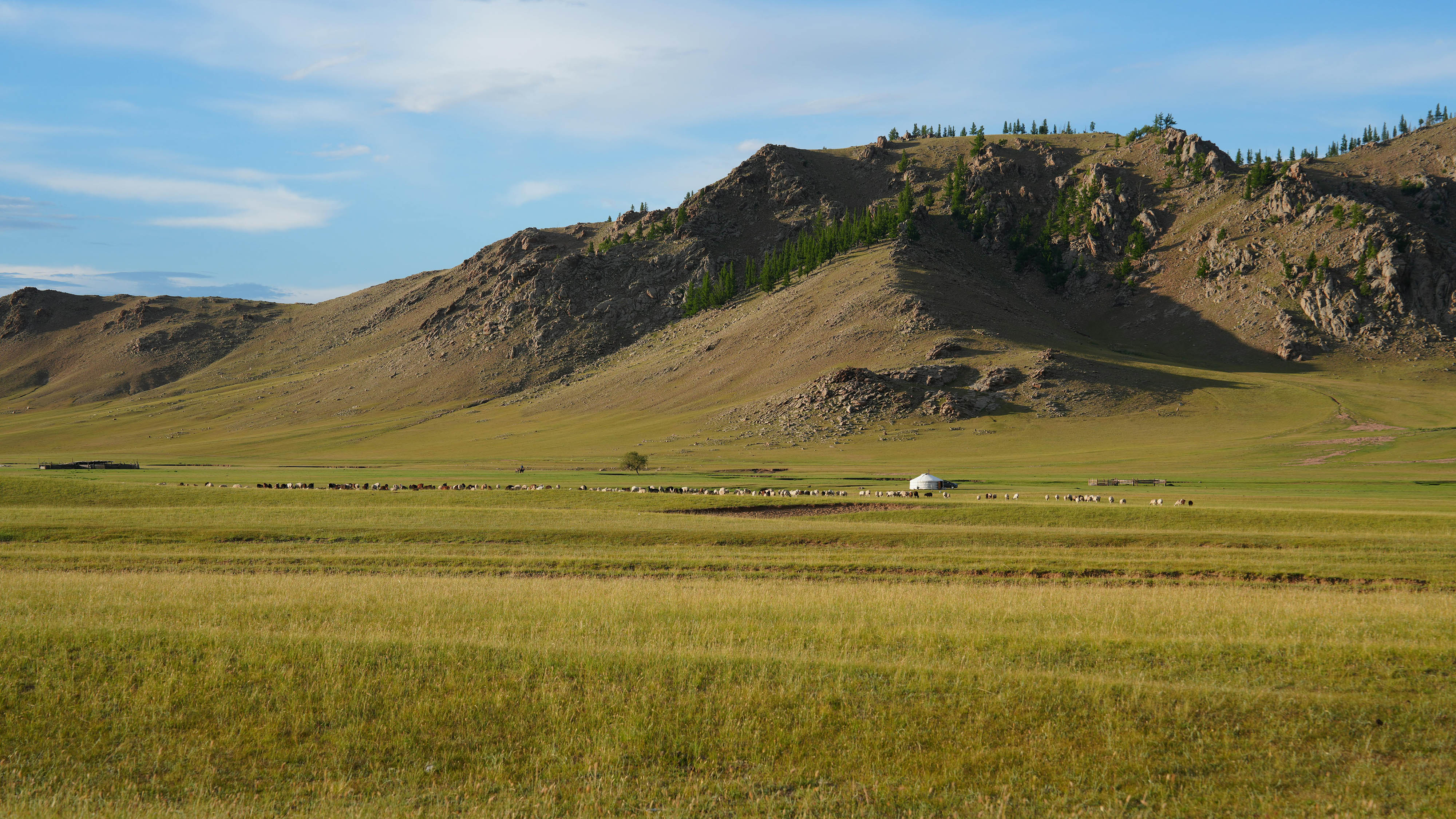
About Mongolia
Mongolia is truly one of the world's last undiscovered travel destinations and the safest country to visit.
Mongolia's recorded history stretches back over 2,000 years to early nomadic confederations, but its defining chapter began in 1206, when Temüjin united the Mongol tribes and was proclaimed Genghis Khan, founding an empire that would become the largest contiguous land empire in history. Centuries of Manchu Qing rule followed (1691–1911), then independence, a 1921 revolution, decades as a Soviet-aligned socialist state, and a peaceful democratic transition in 1990 that established the multi-party system Mongolia still operates under today.
Early History and the Rise of Genghis Khan
Human presence on the Mongolian plateau dates back thousands of years, with a long succession of nomadic confederations, including the Xiongnu, rising and falling across the steppe long before the Mongol Empire existed. For much of this early period, Mongol clans had little inclination to unite, and by the late 12th century, Mongol society remained a loose, often rival collection of tribes rather than a single people.
That changed with Temüjin, a young Mongol leader who spent years building alliances and defeating rival clans. In 1206, at a great assembly (khuriltai) of Mongol leaders, Temüjin was proclaimed Genghis Khan, a title reflecting his position as ruler over a newly unified Mongol nation. No leader before or since has united the Mongol tribes as effectively, and the empire he founded would go on to become the largest contiguous land empire in world history, stretching from the Pacific to Eastern Europe under his successors.
Manchu Qing Rule (1691–1911)
Centuries after the Mongol Empire's peak, Mongolia came under the control of the Manchu Qing Dynasty, formally from 1691 in the case of what became known as Outer Mongolia. Qing rule lasted more than two centuries, ending only with the dynasty's collapse in 1911. As Qing authority crumbled, a group of Mongol princes moved quickly, declaring the Bogd Khan, the reincarnate spiritual head of Mongolian Tibetan Buddhism based in Urga (modern Ulaanbaatar), as the ruler of a newly independent Mongolia.
Buddhism, the Bogd Khan, and the 1930s Purges
Tibetan Buddhism had deep roots in Mongolia by this point, with connections between Mongolian and Tibetan Buddhist tradition stretching back centuries. By 1921, an estimated 110,000 lamas (monks) lived across roughly 700 monasteries nationwide, and monasteries held enormous social and economic influence.
That changed dramatically after the 1921 revolution brought a Soviet-aligned government to power. When the Bogd Khan died in 1924, the Mongolian People's Republic was formally established, and China did not recognize Mongolia's independence for another 22 years, until 1946. Religious suppression escalated sharply through the 1930s: thousands of monks were arrested, and by the end of the decade, tens of thousands of Mongolians, a large share of them monks, had been executed or imprisoned during the Stalinist-era political purges, among the darkest chapters in modern Mongolian history. Nearly all of the country's monasteries were destroyed or closed during this period. Religious freedom did not return until 1990.
The Switch from Traditional Script to Cyrillic
For centuries, Mongolian was written using the traditional vertical Mongolian script, the same script used in classical texts including The Secret History of the Mongols, Mongolia's most important historical chronicle. In the early-to-mid 1940s, under Soviet influence, this traditional script was replaced with a modified Cyrillic alphabet, which has remained in everyday use ever since. Notably, this shift has partially reversed in recent years: since January 2025, Mongolian government bodies have been required to issue official documents in both Cyrillic and the traditional script, with full restoration of the traditional script targeted by 2030. For more detail on this ongoing change, see our guide: Education in Mongolia
The Socialist Period and Ties to the Soviet Union
Mongolia adopted a new constitution in 1960 and joined the United Nations in 1961, cementing its international standing as a socialist state closely aligned with the Soviet Union throughout the Cold War. This alignment shaped Mongolia's economy, education system, and foreign policy for decades.
By the 1980s, Jambyn Batmonkh led Mongolia's government, and reforms in the Soviet Union under Mikhail Gorbachev began to influence political thinking in Ulaanbaatar as well. Relations with China also started to thaw during this period, culminating in the restoration of full diplomatic relations in 1989.
The 1990 Democratic Revolution
In March 1990, large pro-democracy protests and hunger strikes broke out in the square in front of Mongolia's parliament building in Ulaanbaatar. Events moved quickly: Batmonkh lost power, new political parties formed almost overnight, and by May, the government agreed to hold Mongolia's first multi-party elections. That election took place in July 1990, and, notably, the former ruling communist party (the Mongolian People's Revolutionary Party) won it, illustrating just how gradual and negotiated Mongolia's democratic transition actually was, rather than a sudden overthrow.
A new constitution followed in January 1992 under President Punsalmaagiin Ochirbat, formally establishing Mongolia's current democratic, multi-party system and market economy. In 1993, Ochirbat and Russian President Boris Yeltsin signed a new bilateral treaty redefining relations between the two countries, and Ochirbat won Mongolia's first direct presidential election that same year.
Mongolia Through the 1990s and 2000s
Mongolia's young democracy weathered real challenges in its first decade. In 1996, wildfires burned across roughly 106,000 square kilometers of forest and rangeland over more than three months, one of the largest fire events in the country's modern history. In 1997, Ochirbat lost his re-election bid amid economic difficulties, and by 2000, the Mongolian People's Revolutionary Party won a landslide victory, taking around 95% of parliamentary seats, a reminder that Mongolia's political pendulum swung repeatedly between reformist and establishment parties during this formative period.
The 2000s and 2010s brought a major economic shift, driven substantially by mining, particularly copper and coal exports, which transformed Mongolia's economy and drew significant foreign investment, alongside real volatility tied to global commodity prices.
Mongolia's Political System Today
Mongolia's democratic system has continued to evolve well into the 2020s. A 2019 constitutional reform changed the presidency to a single six-year term, and a 2023 reform expanded parliament from 76 to 126 seats under a new mixed electoral system, first used in the 2024 election. For a full breakdown of how Mongolia's government works today, including current leadership, see our guide: Mongolia's Political System Explained
Why This History Matters for Travelers
Mongolia's layered history is visible almost everywhere you go: Genghis Khan's legacy at the Genghis Khan Statue Complex and the ancient capital of Kharkhorin, Buddhist revival at monasteries like Gandantegchinlen and Erdene Zuu, Soviet-era architecture and monuments across Ulaanbaatar, and a genuinely young, still-evolving democracy that shapes daily life across the country today.
Discover Mongolia Travel has operated since 2004 and can help travelers build itineraries that connect this history to real places, from imperial-era sites to modern Ulaanbaatar.
Frequently Asked Questions
When was Genghis Khan given his title?
In 1206, at a great assembly of Mongol leaders, where Temüjin was proclaimed Genghis Khan after uniting the Mongol tribes.
When did Mongolia become independent?
Mongolia declared independence from Qing China in 1911, though full international recognition, including from China itself, didn't come until 1946.
What happened to Mongolia's monasteries in the 1930s?
During Stalinist-era purges, thousands of monks were arrested and tens of thousands of Mongolians were executed or imprisoned, and nearly all of the country's roughly 700 monasteries were destroyed or closed.
Why did Mongolia switch from traditional script to Cyrillic?
Under Soviet influence in the early-to-mid 1940s, Mongolia adopted a modified Cyrillic alphabet to replace the traditional Mongolian script, a change that has partially reversed since a 2025 reform requiring both scripts in government use.
When did Mongolia become a democracy?
Mongolia's democratic transition began with the 1990 Democratic Revolution, following large pro-democracy protests, leading to the country's first multi-party elections that same year and a new constitution in 1992.
Was Mongolia's transition to democracy violent?
No. Unlike some other socialist states of the era, Mongolia's shift to democracy was largely peaceful, achieved through protests, hunger strikes, and negotiation rather than armed conflict.
How has Mongolia's political system changed recently?
A 2019 reform moved the presidency to a single six-year term, and a 2023 reform expanded parliament from 76 to 126 seats under a new mixed electoral system, first used in 2024.
What role did the Soviet Union play in Mongolia's history?
The Soviet Union backed Mongolia's 1921 revolution and remained its closest ally throughout the socialist period, from the 1920s until Mongolia's democratic transition in 1990.