
About Mongolia
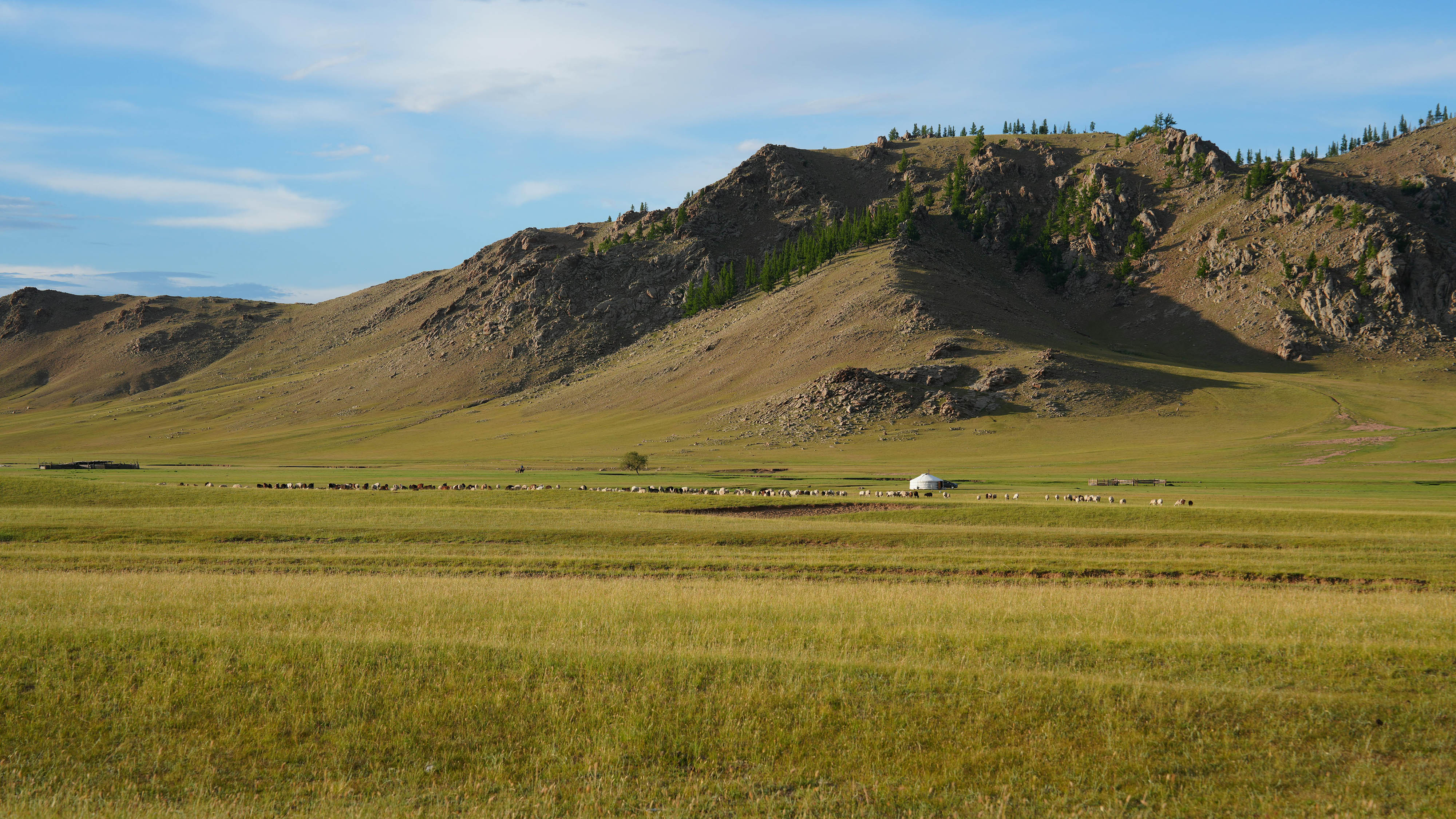
Mongolia is truly one of the world's last undiscovered travel destinations and the safest country to visit.
| Population | 3.5 million |
|---|---|
| Area | 1,566,000 sq km (610,740 sq mi) |
| Land boundaries | 8,158 km, with Russia 3,485 km and with China 4,673 km |
| Average altitude | 1,580 m above sea-level |
| Terrain | Vast semi-desert and desert plains, mountains in west and southwest, Gobi Desert in southeast |
| People | Khalkha Mongols (86%), Kazaks (6%), about a dozen other Mongolian ethnic groups |
| Languages | Mongolian, Kazakh, Russian, Chinese. English is widely spoken in the Ulaanbaatar. |
| Religions | Mongolia's constitution guarantees freedom of religion and has no official state religion, though Buddhism is traditionally and culturally dominant. |
| Literacy rate | 82.9% |
| Climate | Average summer temperature +20'C, average winter temperature -26'C, average rainfall 200-220 mm. Winter lasts from November to late April, Spring from May through June, Summer from July through September. |
| Political system | Mongolia is a parliamentary republic. Its President (Head of State) is elected by popular vote for a single, non-renewable six-year term; the current president is Ukhnaagiin Khürelsükh, who took office in 2021. The Prime Minister (Head of Government) is appointed by the parliament, known as the State Great Khural, for a four-year term. The current Prime Minister is Nyam-Osoryn Uchral, who assumed office on March 30, 2026 |
| Legislature | The State Great Khural is Mongolia's unicameral parliament, which was expanded to 126 members following a 2023 constitutional reform. Its representatives are elected for four-year terms using a mixed electoral system. The last legislative election was held on June 28, 2024 |
| Judicial system | Mongolian judicial system consists of Constitutional Court , Supreme Court, Aimag and capital city courts, soum and district courts. |
| State structure | Mongolia is a unitary state and divided administratively into Aimags (21) and a capital city; Aimags are subdivided into soums; soums into bags; and a capital city into districts; districts into khoroos. |
| National currency | Tugrik (MNT), about MNT 3595 = USD 1 (by Jul 2026) |
| Fiscal year | January 1 - December 31 |
| Main entry points | Chinggis Khaan (airport in Ulaanbaatar ), Sukhbaatar (railway station on Mongolian-Russian border) and Zamyn Uud (railway station on Mongolian-Chinese border) |
| Sea access | Tianjin/China (1,344 km) and Nakhodka/Russia (4,037 km) |
| Public holidays | December 31- January 1 - New Year 3 days, in January/February - Mongolian New Year (Tsagaan Sar), June 1 - Mother and Child day, July 11-13 - National Holiday The Naadam Festival December 29-National Independence day (Land border checkpoints for automobile close on Independence Day, but airports and international train routes remain open) |
| Time | Add 8 hours to Greenwich Mean Time |
| Normal working hours | 09.00-13.00 and 14.00-18.00 |
| Electric current | 220 volts/50 HZ |
| Weight and measures | Metric System |
| Visa arrangements | Mongolian visas can be obtained from Mongolian Embassies and Diplomatic Missions worldwide. Eligible travelers can also use the Official eVisa Portal to secure a digital tourist visa for $53 USD within three business days, completely eliminating the need for an invitation letter. Alternatively, travelers from countries lacking a local Mongolian diplomatic presence may request an exceptional visa on arrival at the airport for $50 to $65 USD, which requires a pre-arranged invitation letter from a registered local tour operator. |