About Mongolia
Mongolia is truly one of the world's last undiscovered travel destinations and the safest country to visit.
Mongolia is divided into seven natural zones, running roughly north to south: the High Mountain Zone, Taiga Forest Zone, Mountain Forest-Steppe Zone, Steppe Zone, Desert-Steppe Zone, Gobi Desert Zone, and scattered Wetlands. Grassland and steppe dominate the country, covering more than three-quarters of the territory, while forest covers about 11.2% of total land area, higher than commonly assumed for a country famous for its deserts and open plains.
Why Mongolia Has So Many Natural Zones
Mongolia sits at the meeting point of two major ecological systems: Siberia's vast taiga forest to the north and the Central Asian steppe and desert belt to the south. This position, combined with a wide range of elevation, from high alpine peaks to low desert basins, gives Mongolia an unusually diverse set of ecosystems for a landlocked country of its size.
1. High Mountain Zone
Mongolia is, on average, a genuinely mountainous country, sitting at an average elevation of around 1.5 kilometers above sea level. Roughly 5% of the country's territory lies high enough to qualify as true High Mountain Zone, sitting above the tree line and facing extreme conditions: strong winds, bitter cold, and a very short growing season.
- Landscape: tundra, alpine-sedge meadows, upland swamps, and lichen-covered boulder fields, often showing clear signs of past glaciation, including U-shaped valleys
- Plants: shrubby ground birch, occasional mountain pine, white gentian, and mountain saxifrage
- Wildlife: argali wild sheep, ibex, snow leopard, ermine, snow marten, and mountain hare, along with birds including the white ptarmigan and Altai snowcock
This zone is found across the highest sections of the Altai, Khangai, Khentii, and Khuvsgul mountain ranges.
2. Taiga Forest Zone
Northern Mongolia forms the southern edge of Siberia's vast taiga, the largest forest biome on Earth. In Mongolia, this zone covers around 5% of the country's total territory, occurring specifically in the Khentii Mountains, the mountainous terrain around Lake Khuvsgul, parts of the Tarvagatai range, and areas around the Orkhon River valley.
- Climate: cooler and wetter than most of Mongolia, receiving roughly 300–400 mm of precipitation annually, which shortens the growing season further
- Trees: Siberian larch is the most widespread species, alongside Siberian cedar and pockets of spruce, pine, and fir
- Wildlife: home to species less commonly associated with Mongolia, including moose, brown bear, and wolverine, alongside more widespread species like wolves and red deer
3. Mountain Forest-Steppe Zone
This transitional zone blends forest and grassland and is widely considered the richest zone in Mongolia for both plant and animal diversity. Conifer forests typically grow on the shadier northern slopes of hills and mountains, while grassland and drier vegetation dominate the sunnier southern slopes, a distinctive Mongolian landscape pattern visible across much of central and northern Mongolia.
4. Steppe Zone
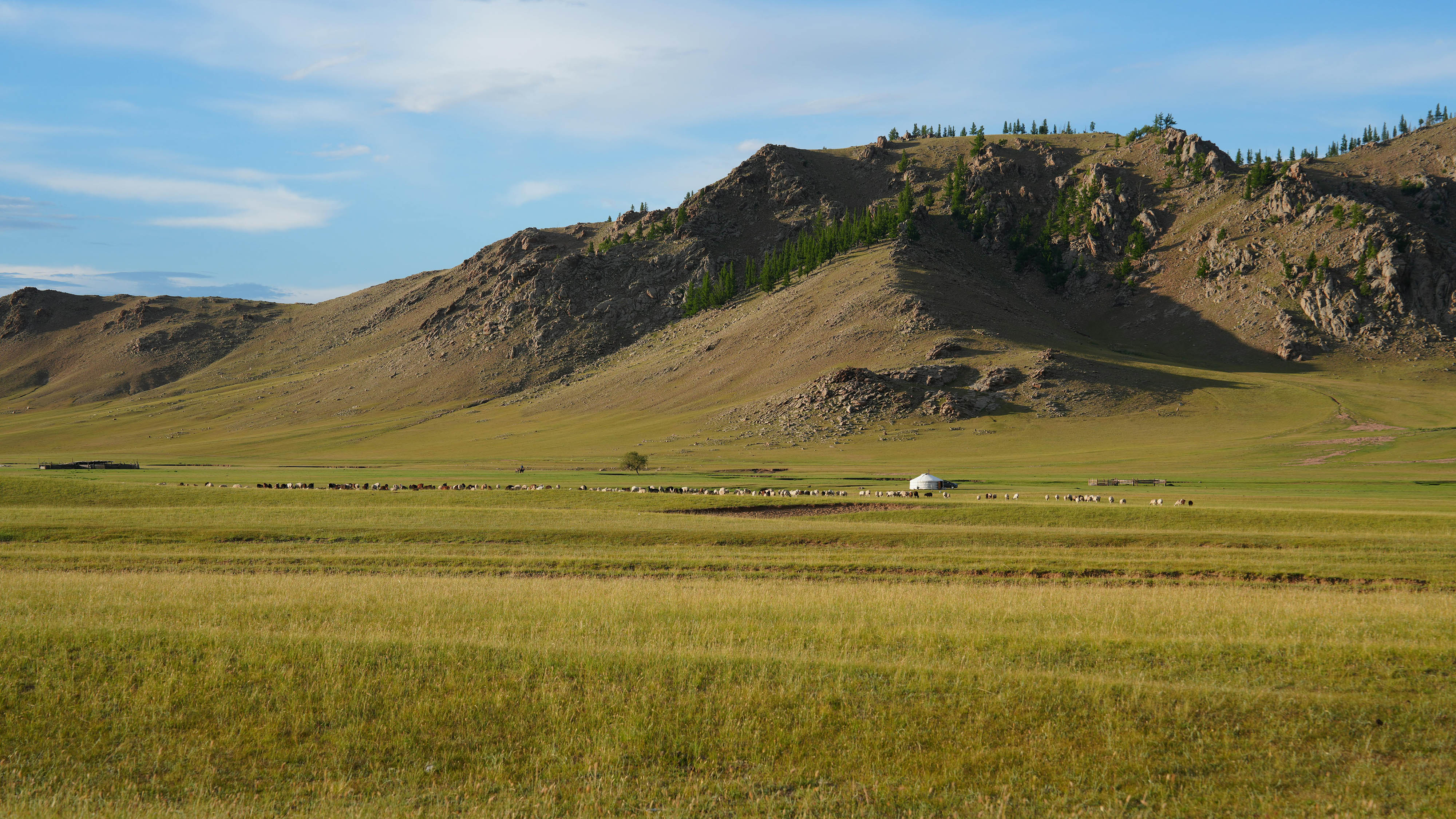
Steppe, Mongolia's iconic open grassland, dominates more of the country than any other single zone, with grassland and forest-steppe together covering more than three-quarters of Mongolia's total territory. This is the landscape most associated with Mongolia internationally: vast, rolling, largely treeless plains that have supported nomadic herding for thousands of years.
- Soils: predominantly chestnut and brown steppe soils
- Use: the primary grazing land for Mongolia's livestock economy, home to the majority of the country's nomadic and semi-nomadic herding population
- Notable area: the Menengiin Tal in eastern Mongolia, one of the largest intact steppe grasslands remaining anywhere in the world
5. Desert-Steppe Zone
Desert-steppe forms a wide transitional band between the steppe and true desert zones, covering more than 20% of Mongolia's territory. It includes the Depression of the Great Lakes, the Valley of the Lakes, much of the area between the Khangai and Altai mountain ranges, and parts of the eastern Gobi region.
- Climate: arid, with frequent drought, annual precipitation of only about 100–125 mm, and strong winds that regularly produce dust storms
- Terrain: includes low-lying basins, salt pans, and small seasonal ponds
- Use: despite the harsh conditions, this zone still supports meaningful numbers of nomadic herders
6. Gobi Desert Zone
The Gobi is one of the world's great deserts, dominating much of southern Mongolia and extending into northeastern China. Despite its reputation, the Gobi is far more varied than a simple sand sea, made up largely of gravel plain and rock, with sand dunes covering only a small fraction of the total area.
- Vegetation: sparse but present, including drought-tolerant saxaul shrubs, used locally as firewood, and groves of elm and poplar clustered around springs and other water sources
- Wildlife: wild Bactrian camels, Gobi bears, snow leopards in the surrounding mountains, and a range of desert-adapted species found nowhere else
For a deeper look at this zone specifically, see our guide: Gobi Desert Mongolia: Ecosystem, Weather, and Travel Guide
7. Wetlands
Scattered across several of Mongolia's other zones, wetlands form a smaller but ecologically significant category of their own, particularly around lakes in the Valley of the Lakes region and along river systems. These areas provide critical habitat for water birds and other species that can't survive in the surrounding arid or semi-arid terrain, making them disproportionately important for biodiversity relative to their size.
How Mongolia's Zones Compare
- Most extreme climate: the High Mountain Zone, with the shortest growing season and harshest winds
- Richest biodiversity: the Mountain Forest-Steppe Zone, where forest and grassland species overlap
- Largest by area: the Steppe Zone, covering the majority of the country
- Most iconic for travelers: the Gobi Desert Zone, despite covering less territory than the steppe
- Most overlooked: Wetlands, small in total area but disproportionately important for bird and wildlife habitat
Why This Matters for Travelers
Mongolia's natural zones aren't just a geography lesson, they largely determine what kind of trip you'll have depending on where you go. A journey through the Taiga Forest Zone near Lake Khuvsgul looks and feels almost nothing like a trip through the Gobi Desert further south, despite both being part of the same country. Understanding these zones helps set realistic expectations for climate, wildlife, and scenery on any given route. For a broader look at the species found across these zones, see our guide: Animals of Mongolia: Wildlife Guide for Travelers
Discover Mongolia Travel has operated since 2004 and designs itineraries that span multiple natural zones, from taiga forest to open steppe to true desert, depending on what each traveler wants to experience.
Frequently Asked Questions
How many natural zones does Mongolia have?
Mongolia has seven recognized natural zones: High Mountain, Taiga Forest, Mountain Forest-Steppe, Steppe, Desert-Steppe, Gobi Desert, and Wetlands.
What percentage of Mongolia is forest?
Forested land covers about 11.2% of Mongolia's total territory, a higher percentage than many people expect given the country's reputation for open steppe and desert.
What is the largest natural zone in Mongolia?
The Steppe Zone is the largest, with grassland and forest-steppe together covering more than three-quarters of the country's total territory.
Which zone has the richest wildlife in Mongolia?
The Mountain Forest-Steppe Zone is generally considered the richest for both plant and animal diversity, since it blends forest and grassland habitats.
Is the Gobi Desert the largest zone in Mongolia?
No, Despite being Mongolia's most internationally famous landscape, the Gobi Desert Zone covers less territory than the Steppe Zone.
Where is Mongolia's taiga forest located?
Mongolia's taiga forest, the southern edge of Siberia's larger taiga biome, is found mainly in the Khentii Mountains, around Lake Khuvsgul, and in parts of the Tarvagatai and Khan Khukhii mountain ranges.
What wildlife lives in Mongolia's High Mountain Zone?
Argali wild sheep, ibex, snow leopard, ermine, and snow marten are among the mammals found in this zone, along with birds like the Altai snowcock.
Why does Mongolia have such varied ecosystems for its size?
Mongolia sits at the meeting point of Siberia's taiga forest and the Central Asian steppe and desert belt, and its wide elevation range, from alpine peaks to low desert basins, adds even more ecological variety.