
What Apps Do You Need in Ulaanbaatar? 10 Useful Mongolia Travel Apps for 2026
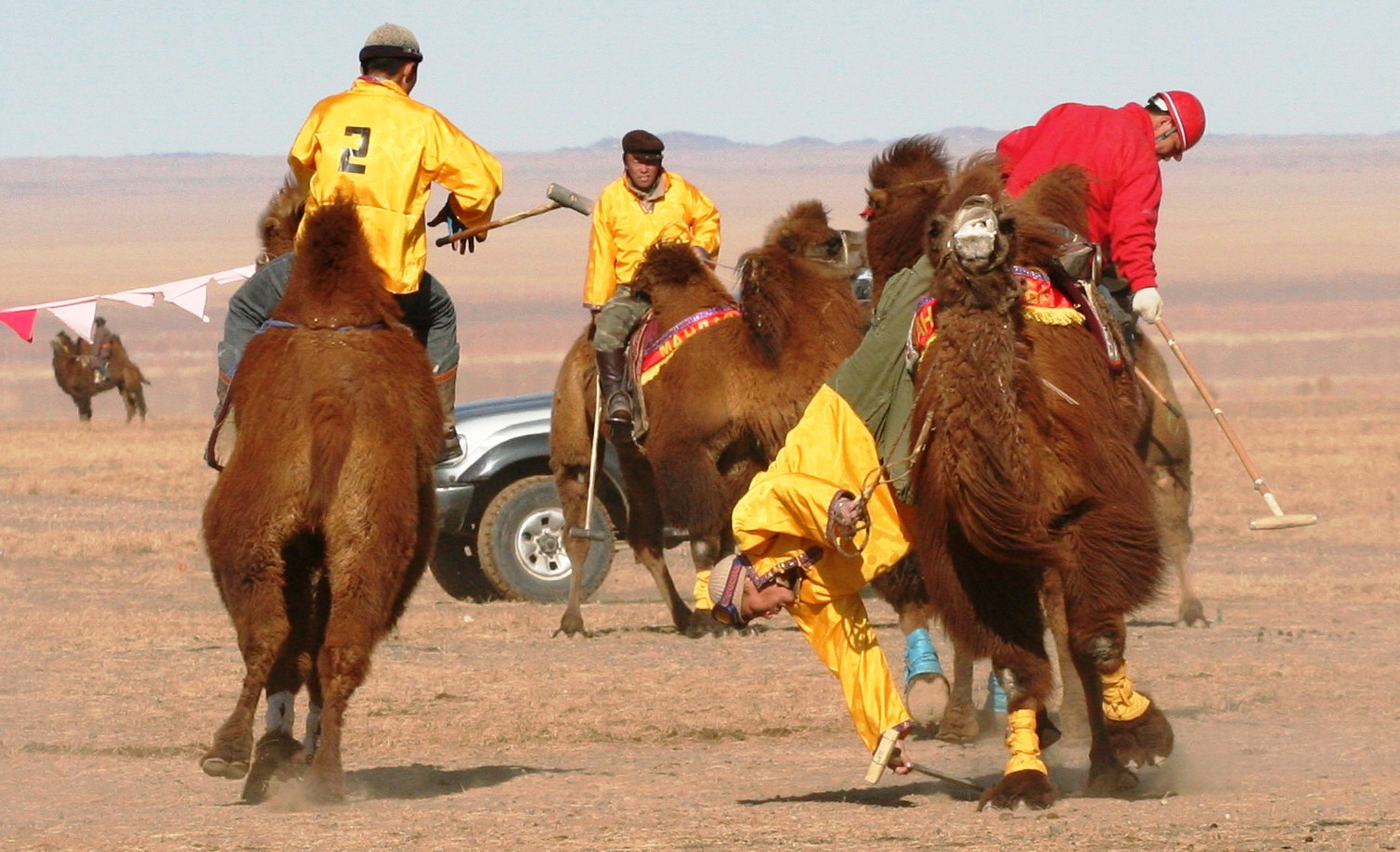
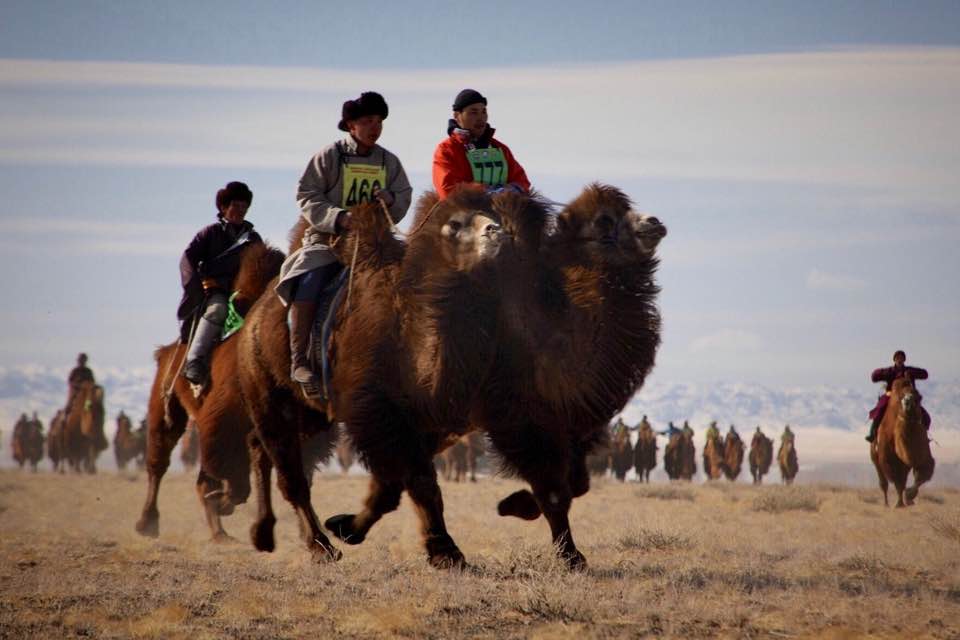
Camel polo is one of Mongolia's most unusual winter sports. Riders compete on two-humped Bactrian camels, combining horsemanship-style skills with an animal that has been central to life in the Gobi for generations. One remarkable camel polo event took place at Tsonjin Boldog in 2013, when some herders traveled more than 1,000 km to participate. Today, camel polo remains part of several camel festivals that celebrate Gobi culture, herding skills, and Mongolia's growing domestic camel population.
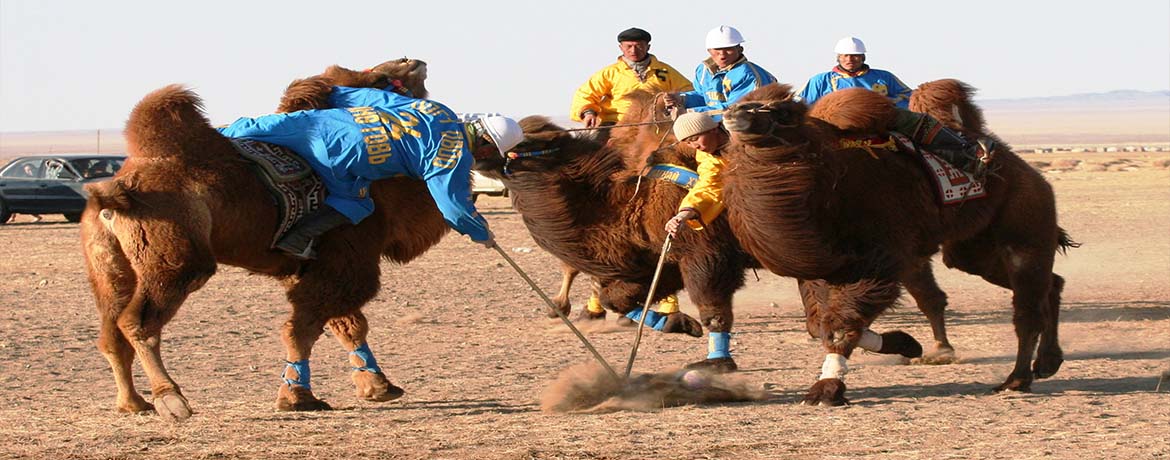
Camel polo is a team sport played on two-humped Bactrian camels. Riders use long mallets to move a ball toward the opposing team's goal while controlling their camels across an open field.
The sport is now included in camel festivals and winter events in Mongolia. These gatherings also feature camel races, traditional clothing, camel products, herding skills, and other activities connected with Gobi pastoral culture.
Yes. In March 2013, a camel polo festival was held at the Chinggis Khaan Statue Complex at Tsonjin Boldog in Tuv Province.
Contemporary reports say herders from remote parts of Bayankhongor traveled more than 1,000 km to reach the event. Participants also arrived from places including Gurvantes in Umnugovi, Ulaanbadrakh in Dornogovi, and Delgerkhangai in Dundgovi.
More than 150 camels from over 20 soums in six aimags took part.
For an animal associated with long-distance travel through harsh landscapes, the journey was an impressive demonstration of the endurance of Mongolia's domestic Bactrian camels.
The event described in the original Discover Mongolia article took place on March 9–10, 2013.
This is important because the existing blog was published in 2019 but uses wording such as “this year's games,” which makes the event appear six years more recent than it actually was.
Official cultural announcements from the period identify the event as the Camel Polo 2013 Winter Festival at Tsonjin Boldog. The program included a camel parade, polo competition, camel racing, traditional clothing displays, performances, and exhibitions of camel milk and wool products.
Camel polo events had normally been associated with Mongolia's Gobi provinces, where most domestic camels are raised.
The 2013 event brought camel culture much closer to Ulaanbaatar by holding the competition at the Chinggis Khaan Statue Complex at Tsonjin Boldog.
The organizers wanted more people, including international visitors and younger Mongolians, to see Bactrian camels, camel sports, and Gobi herding traditions. Contemporary reports describe the event as part of a wider effort to promote camel husbandry and winter tourism.
Camel polo has the basic idea of traditional polo but replaces horses with Bactrian camels.
Riders compete in teams, control their camels while carrying long mallets, and attempt to strike a ball toward the opposing goal.
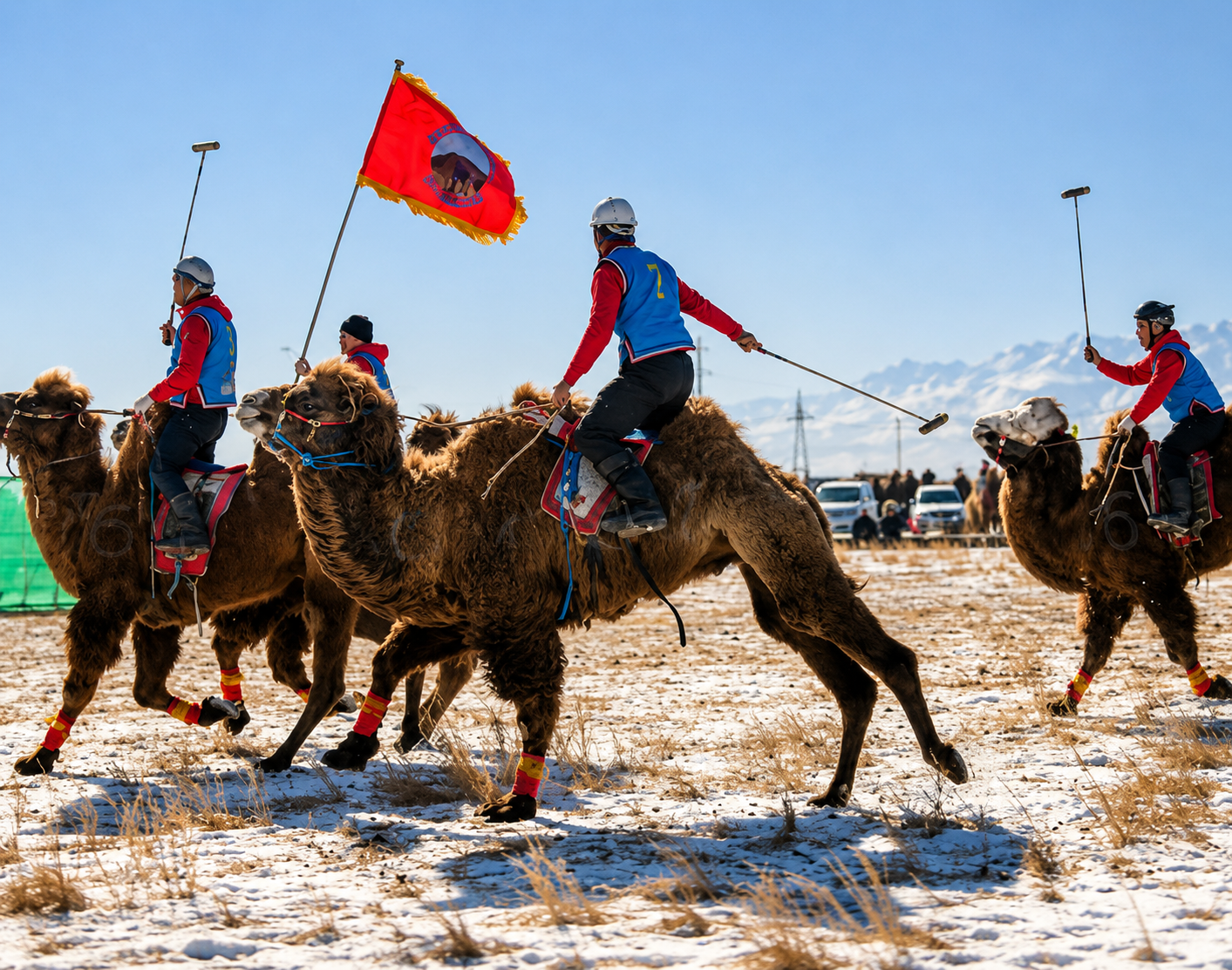
The result looks familiar and completely unusual at the same time.
Camels move differently from horses. Their height, longer stride, slower acceleration, and distinctive body movement change the rhythm of the game.
Camel polo therefore tests more than the rider's ability to hit the ball. Riders must also understand how their camel turns, accelerates, stops, and responds in a crowded competition.
The two sports share a basic idea, but watching them feels very different.
This cultural setting is what makes camel polo particularly interesting for travelers.
Yes. The camels traditionally herded across Mongolia's Gobi are domestic Bactrian camels, known for their two humps.
They are well adapted to the dry and extremely cold environments of Central Asia. For Gobi households, camels can provide milk, wool, meat, transport, and income. A 2025 academic study describes the two-humped camel as continuing to play important economic and cultural roles for Mongolian pastoralists.
Their ability to travel long distances and tolerate difficult environments helps explain why they became such an important animal for communities across Mongolia's desert and semi-desert regions.
This is an important distinction.
The domestic Bactrian camels seen at festivals and herding camps are not the same species as Mongolia's wild camels.
Mongolia counted approximately 501,300 domestic camels at the end of 2025, up 4.3% from the previous year. Mongolia's president stated in January 2026 that the national camel population had roughly doubled over the previous 20 years, from about 254,000 to 501,000.
The wild camel, Camelus ferus, is a separate species living in remote parts of Mongolia and China and is currently classified as Endangered on the IUCN Red List.
So articles should not describe every two-humped camel at a Mongolian festival as an endangered wild Bactrian camel.
The old article gives figures of around 900,000 camels in 1950, about 200,000 in 2002, and roughly 300,000 at the time of the event.
The general story of a major decline followed by recovery is correct, but newer statistics are available.
Official Mongolian information records a historical high of about 895,000 camels in 1954. Numbers later fell sharply, reaching roughly a quarter-million animals around two decades ago.
By the end of 2025, Mongolia had 501,300 camels according to National Statistics Office data.
That means the camel population has recovered substantially, although it remains well below its mid-20th-century historical peak.
Camel festivals cannot increase camel numbers by themselves, but they can give herders another reason to maintain skills, animals, and products connected with camel husbandry.
Modern festivals promote:
The 2026 national camel herders' event in Dundgovi, for example, included camel polo, racing, camel archery, relay competitions, traditional equipment-making, and exhibitions of camel products.
This gives camel festivals an economic and cultural purpose beyond entertainment.
One of the most impressive moments in modern Mongolian camel culture happened in 2016.
At a festival in Dalanzadgad, Umnugovi Province, 1,108 camels and riders completed a race, setting the Guinness World Record for the largest camel race. The course was just over 15 km long.
1,108 camels set a Guinness World Record in Mongolia.
The fastest camel completed the course in 35 minutes and 12 seconds, while the entire field finished within 1 hour and 8 minutes.
The record remains one of the strongest examples of the scale that Mongolia's camel festivals can reach.
The major camel celebration most international travelers encounter today is often called the Thousand Camel Festival or Ten Thousand Camel Festival, depending on the English translation used.
The festival began in Umnugovi in 1997 and was created to promote camel breeding, camel culture, and Gobi tourism.
Typical events include camel races, polo, traditional clothing competitions, camel-herding demonstrations, and displays of camel products.
In 2026, the Tumen Temee Festival was held in Dalanzadgad on February 6–8. Local government information describes it as a major winter event promoting Gobi nomadic culture.
Yes. Camel polo remains part of current camel festivals rather than being only a historical sport from the 2013 Tsonjin Boldog event.
In January 2026, a national camel festival and camel herders' conference in Mandalgobi included camel polo among eight official camel competitions.
Camel polo also continues to appear in Gobi festival programs.
This makes the sport a living part of modern camel culture, although individual events, locations, and schedules can change from year to year.
The old Discover Mongolia article says ancient petroglyphs prove Mongolians practiced camel polo during the 13th century.
I would not present that claim as established history.
The same story appears in some Mongolian media coverage of the 2013 event, but I could not find a reliable archaeological source identifying a specific 13th-century petroglyph as evidence of organized camel polo.
The modern sport is interesting enough without giving it an ancient date that cannot be properly verified.
It is safer to say that camels have a long history in Mongolian pastoral life, while organized modern camel polo competitions developed much more recently.
For visitors, a camel may be something to ride once beside the sand dunes.
For Gobi herders, its role is much larger.
Camels have traditionally provided:
Recent research also notes their continuing role in tourism and sports.
This is why camel festivals focus not only on racing or polo but also on herders, products, equipment, clothing, and traditional knowledge.
Mongolia's biggest camel festivals usually take place during the cold season.
The 2026 Tumen Temee Festival in Dalanzadgad was held from February 6–8, while another national camel festival took place in Mandalgobi on January 24–25.
Future dates can change, so travelers should confirm the exact schedule before booking flights or accommodation.
Winter travel in the Gobi also requires more preparation than a normal summer tour.
If seeing camel polo or a major camel festival is one of your reasons for visiting Mongolia, plan around the event rather than assuming it can be added casually to a normal itinerary.
A few practical tips:
Discover Mongolia has organized tailor-made journeys since 2004 and can combine Gobi festivals with camel-herding communities and other southern Mongolia destinations.
What is camel polo in Mongolia?
Camel polo is a team sport played on two-humped Bactrian camels. Riders use mallets to strike a ball while controlling their camels, and the sport often appears at Mongolia's winter camel festivals.
Did camels really travel 1,000 km for a polo festival in Mongolia?
Yes, contemporary reports from the 2013 Tsonjin Boldog Camel Polo Festival state that some herders traveled more than 1,000 km from remote parts of Bayankhongor. More than 150 camels from over 20 soums in six aimags participated in the event.
When was the Tsonjin Boldog Camel Polo Festival?
The event described in the original Discover Mongolia article took place on March 9–10, 2013. The existing page was published in 2019, which is why the date needs to be clarified.
Are the camels used for polo wild Bactrian camels?
No, camel polo uses domesticated two-humped Bactrian camels. Mongolia's wild camel is a separate species called Camelus ferus and should not be confused with the domestic animals owned by Gobi herders.
How many camels are there in Mongolia?
Mongolia counted approximately 501,300 domestic camels at the end of 2025. The national population has roughly doubled over the previous two decades.
Does Mongolia have a world record for camel racing?
Yes, 1,108 camels and riders completed a race in Dalanzadgad on March 7, 2016, setting the Guinness World Record for the largest camel race. The course was slightly more than 15 km long.
When is Mongolia's main camel festival?
Major Gobi camel festivals are normally held during winter, but exact dates can change. In 2026, the Tumen Temee Festival took place in Dalanzadgad from February 6–8.
Can tourists watch camel polo in Mongolia?
Yes, travelers can see camel polo when it is included in a current camel festival program. Because individual schedules and venues change, it is best to confirm the specific year's program before planning a trip around the sport.
Discover Mongolia has organized tailor-made tours since 2004.
We handle flights, accommodation, guides, vehicles — you focus on the journey.